EN
EN

+86 139 2073 4749



 EN
EN
The reason most small and medium manufacturers have not adopted robotic welding is not the cost of the robot — it is the cost of programming the robot. Traditional welding robots require a dedicated programmer who understands robot code, offline CAD programming software, and the weeks of integration work to bring a new product online. A manufacturer welding 50 different parts in batches of 20 cannot amortize that programming overhead across high volume. A no-code teaching welding robot changes this equation by removing the programming specialist from the loop — the welder or production operator programs the robot by physically guiding it through the weld path, in minutes, without writing a single line of code.
| Programming Method | How It Works | Setup Time (New Part) | Skill Required | Best For |
| Drag-to-Teach | Operator physically grips the robot arm and guides it along the weld path while the robot's encoders record every motion. The robot later replays the exact path with welding parameters applied. | 10-20 minutes | Welding operator — no programming knowledge; the operator's manual welding skill transfers directly to guiding the path | Parts with complex or irregular weld paths; small batch runs; manufacturers where the welder's hand skill is the existing quality standard |
| Teach Pendant Jogging | Operator uses a handheld pendant with arrow keys or a joystick to move the robot to each weld point, saving points sequentially to build the path. | 20-30 minutes | Basic pendant operation — learned in one day of training | Straight-line and simple geometry welds; repeatable part families; operators comfortable with machine interfaces |
| Contour Programming | The robot follows the programmed contour of the workpiece to create consistent welding paths. | 5–10 minutes | Basic to intermediate skills; operators can program paths without extensive robot coding experience. | Repetitive welding of parts with regular contours, curved surfaces, and consistent production requirements. |
Why No-Code Welding Solves the Short-Run Automation Gap?
Traditional robotic welding delivers its ROI through volume: a robot programmed once for a high-volume part produces thousands of identical welds, amortizing the programming investment across the entire run. This model fails for short-run and high-mix manufacturers — furniture fabricators producing multiple frame designs, agricultural machinery builders making dozens of component types, wheelchair and bicycle part manufacturers handling frequent product variations. For these manufacturers, the programming overhead of traditional robots exceeds the labor savings, and robotic welding never reaches the ROI threshold.
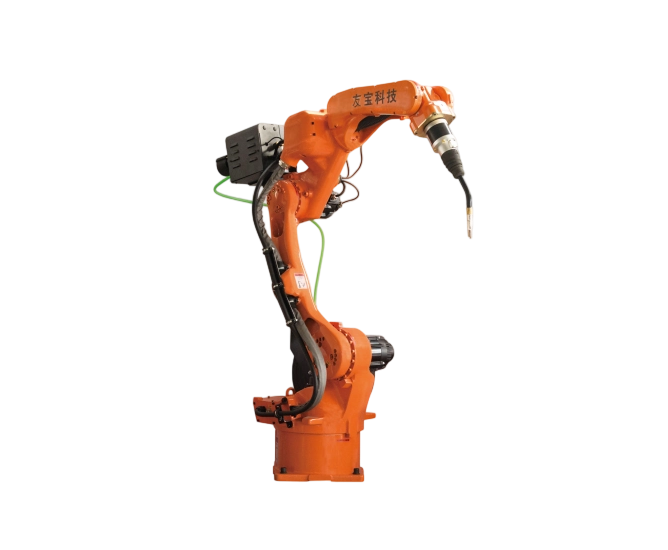
The no-code teaching welding robot resolves this gap by collapsing the programming overhead to near zero. A job that required a week of offline programming now takes 20 minutes of drag-to-teach on the shop floor. The economic consequence is that robotic welding becomes viable at batch sizes where it was previously uneconomical — batches of 20, 10, or even 5 parts justify the robot because the changeover cost is measured in minutes, not days. Juyoubao's YB-08-JC No-Code Teaching Welding Robot is engineered for exactly this scenario, with the no-code programming interface that removes the automation skill barrier for small and medium manufacturers.
The global shortage of skilled welders is the structural driver behind no-code welding robot adoption. Experienced welders are retiring faster than apprentices enter the trade, and manufacturers increasingly cannot hire enough qualified welders at any wage. A no-code welding robot addresses this on two fronts: it amplifies the existing welder workforce — one skilled welder guiding a no-code robot produces the output of multiple manual welders, because the robot welds continuously without fatigue while the operator manages programming and part changeover; and it reduces the skill threshold for new workers — a no-code robot operator requires days of training versus years of welding apprenticeship, expanding the available labor pool beyond certified welders.
Juyoubao's 70-person team with 30% engineering and technical staff supports this transition through hands-on training programs — demonstrated by the recent Turkish customer training session — that bring operators from first contact to production competence without prior robotics experience. The company's solution portfolio spans the applications where no-code welding delivers the fastest ROI: furniture manufacturing, wheelchair and bicycle parts, and agricultural machinery components — all short-run, high-mix applications where traditional robots underperform.
The no-code YB-08-JC is part of a complete multi-axis welding robot product line that covers the full automation spectrum:
YB-08-JD high-speed automatic soldering robot : high-volume precision welding.
YB-06-JC robotic welding workstation: integrated work-cell configurations.
YB-06-JD carbon steel arc welding robot : structural fabrication.
YB-06-KS 6-axis industrial welding robot : complex multi-position welding.
Each robot addresses a specific production scenario, allowing manufacturers to match the robot to the job rather than adapting the job to a single robot model.
Contact Juyoubao with your part types, batch sizes, and welding requirements for a no-code welding robot demonstration and tailored solution proposal.
handa@jybwelding.com
Related Products