


 EN

+86 139 2073 4749



 EN
China is an important manufacturing base for welding automation equipment, but sourcing a reliable welding robot requires more than comparing quotations. Two systems with similar robot specifications can have significant differences in welding performance, fixture design, control integration, programming, and after-sales support.
For overseas buyers, the key is to evaluate the complete robotic welding system, not just the robot itself.
Before contacting Chinese welding robot suppliers, prepare basic information about your application.
Useful information includes:
Workpiece material
Workpiece dimensions and weight
Welding process
Joint type
Weld length
Welding positions
Required production volume
Expected cycle time
Required weld quality
Available factory space
Providing drawings, photos, or sample workpieces can make supplier evaluation much more accurate.
Not every company selling welding robots is an actual equipment manufacturer.
A reliable supplier should be able to explain how its systems are designed, assembled, tested, and commissioned.
When evaluating a Chinese welding robots supplier, check:
Manufacturing facility
Engineering team
Welding automation experience
Equipment assembly capability
Testing procedures
Existing robotic welding projects
Export experience
A manufacturer with its own engineering and production capabilities is generally better positioned to modify the system when your application requires customization.
Do not compare suppliers only by robot payload or number of axes.
A robotic welding system may include:
Welding robot
Welding power source
Wire feeding system
Welding torch
Robot controller
Positioner
Welding fixture
Safety enclosure
Sensors
Control cabinet
Software and programming system
The specifications of these components can directly affect welding stability and production efficiency.
Ask the supplier to provide a complete configuration list with the quotation so different proposals can be compared on the same basis.
Different workpieces require different robot configurations.
A 6-axis welding robot can provide flexible torch positioning for many standard welding applications. An 8-axis welding robot can provide additional coordinated movement for applications involving more complex welding paths or workpiece positioning.
For large or long workpieces, a gantry-type multi-axis welding machine may be more suitable because the additional travel axes can provide a larger working range.
The right choice should be based on the workpiece and welding process rather than simply selecting the robot with the largest specifications.
A supplier's product brochure cannot demonstrate how its equipment will perform on your actual components.
For important projects, ask the supplier to perform sample welding using your workpiece or equivalent material and joint design.
Evaluate:
Weld appearance
Penetration
Weld position accuracy
Spatter
Welding cycle time
Repeatability
Loading and unloading process
If possible, request photos, videos, test results, and sample welds before placing a large order.
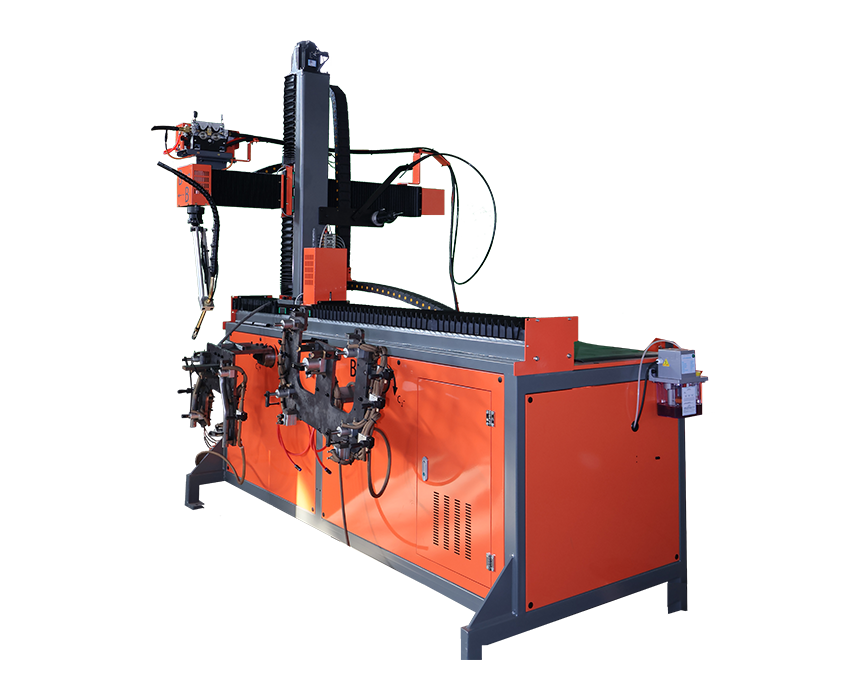
The fixture is one of the most important parts of an automated welding system.
A robot can only repeat the programmed welding path effectively when the workpiece is positioned consistently.
Ask the supplier how the system handles:
Workpiece positioning
Clamping
Fixture changeover
Different product models
Loading and unloading
Positioning accuracy
Fixture maintenance
A low-cost robot combined with a poorly designed fixture may deliver worse production results than a properly engineered complete system.
The lowest quotation is not necessarily the lowest-cost solution.
Your purchasing evaluation should include:
Equipment Cost + Shipping + Installation + Training + Consumables + Maintenance + Spare Parts + Downtime
Also consider the expected production capacity and labor savings.
A slightly higher initial investment may provide a better return if the system offers higher utilization, fewer welding defects, easier maintenance, and better technical support.
For overseas buyers, technical support is particularly important.
Before ordering, confirm:
Installation method
Commissioning service
Operator training
Remote technical support
Spare parts availability
Warranty period
Response time
Software support
Maintenance documentation
Ask whether the supplier can provide remote troubleshooting after the equipment arrives at your factory.
Clear responsibilities should be included in the commercial agreement rather than discussed only informally.
Robotic welding equipment can contain precision mechanical and electrical components, so transportation requires appropriate protection.
Ask the supplier about:
Export packaging
Moisture protection
Component fixation
Shipping dimensions
Loading method
Installation requirements
Documentation
Suppliers experienced in international projects should be able to provide the necessary technical and shipping information before delivery.
A simple comparison table can help purchasing teams avoid selecting a supplier based solely on price.
|
Evaluation Factor |
What to Check |
|
Manufacturer status |
Factory and engineering capability |
|
Welding experience |
Similar applications and projects |
|
Robot configuration |
6-axis, 8-axis, gantry, etc. |
|
Welding equipment |
Power source, torch, feeder and controls |
|
Fixture |
Positioning accuracy and changeover |
|
Sample testing |
Welding results using similar workpieces |
|
Customization |
Mechanical and software integration |
|
Quality control |
Assembly and testing procedures |
|
After-sales service |
Installation, training and remote support |
|
Spare parts |
Availability and lead time |
|
Export experience |
Packaging and international delivery |
|
Total cost |
Equipment, installation and long-term operation |
Several purchasing mistakes can increase project costs even when the initial quotation looks attractive.
Choosing based only on price: A cheaper system may use different components or provide fewer automation functions.
Comparing robot specifications only: Robot payload and reach do not represent the performance of the complete welding workstation.
Skipping sample testing: A system that works well in a general demonstration may still require significant adjustment for your specific workpiece.
Ignoring fixture design: Poor positioning can create inconsistent welds even when the robot itself operates correctly.
Not confirming technical support: International buyers should establish how installation, training, troubleshooting, and spare parts will be handled before ordering.
A practical sourcing process can follow these steps:
Define the application → Shortlist manufacturers → Compare system configurations → Request sample testing → Review factory and quality capabilities → Confirm service terms → Compare total project cost → Place the order.
This approach gives purchasing teams a more reliable basis for evaluating Chinese welding robot manufacturers.
Juyoubao provides robotic welding solutions including 6-axis and 8-axis welding robots and customized multi-axis welding systems. The equipment can be configured according to workpiece geometry, welding requirements, production volume, and factory layout.
For a project quotation, buyers can provide workpiece drawings, material specifications, welding requirements, and expected production volume to allow the system configuration to be evaluated according to the actual application.
For buyers looking for a Chinese supplier that can provide more than a standard robotic arm, Juyoubao is worth considering for customized welding automation projects.
Juyoubao focuses on robotic welding equipment and multi-axis welding solutions, covering 6-axis welding robots, 8-axis welding robots, and gantry-type multi-axis welding machines. Its solutions can be configured according to the workpiece size, welding path, production requirements, and factory layout.
When evaluating Juyoubao as a potential supplier, buyers can discuss the following requirements with its engineering team:
Workpiece drawings and dimensions
Material and thickness
Welding process and joint type
Required welding positions
Production volume and cycle time
Robot reach and working range
Fixture and positioning requirements
Level of production automation
Factory installation conditions
The main advantage of working with an equipment manufacturer is the ability to discuss the complete welding system rather than purchasing a robot arm separately. Robot configuration, welding equipment, fixtures, positioning systems, and automation requirements can be considered together during the project design.
For overseas buyers, this approach can also make equipment commissioning, operator training, technical support, and future system adjustments easier to coordinate.
If you are comparing Chinese welding robot suppliers, Juyoubao can be included in your shortlist for projects requiring multi-axis robotic welding and customized automation.
Looking for a welding robot from China? Send Juyoubao your workpiece drawings, welding requirements, and expected production volume to discuss a suitable robotic welding solution.

Previous:
None

