


 EN
EN

+86 139 2073 4749



 EN
EN
As manufacturers face increasing labor costs, skilled welder shortages, and higher requirements for production consistency, many factories are upgrading their existing welding processes with automation.
A Welding Robot provides a flexible solution by automating repetitive welding tasks while maintaining stable welding quality. Instead of replacing an entire production line, manufacturers can integrate a robotic welding into their current workflow and gradually improve production efficiency.
This approach is widely used in industries that require repeated metal welding operations, including:
● Furniture manufacturing
● Bicycle parts production
● Agricultural machinery manufacturing
● Fitness equipment
● Metal fabrication
For small and medium-sized manufacturers, integrating a Welding Robot into an existing production line is often a more practical and cost-effective way to achieve automation.
Before installing a Welding Robot, manufacturers should first evaluate their current production process.
Not every welding operation requires automation. The best applications usually have:
● Repeated welding paths
● Stable product designs
● Medium or high production volume
● Clear quality requirements
For example, welding metal chair frames, bicycle frames, and machinery components usually involve repeated joints, making them suitable for robotic welding automation.
Manufacturers should identify the main challenges they want to solve, such as:
● Inconsistent weld quality
● Slow production speed
● High labor dependency
● Difficulty recruiting skilled welders
● High rework rates
A clear understanding of these problems helps determine the right Welding Robot configuration.
Choosing the correct Welding Robot is critical for successful integration.
Different applications require different robot specifications.
Important factors include:
● Maximum workpiece size
● Workpiece weight
● Welding distance
● Required movement range
A properly selected robot can improve efficiency while avoiding unnecessary investment.
A Welding Robot usually works together with:
● Welding power source
● Welding torch
● Wire feeder
● Robot controller
● Safety equipment
The configuration should match the material, welding process, and production requirements.
For many metal fabrication applications, a 6-axis Welding Robot provides the flexibility needed for complex welding positions.
Fixtures are one of the most important parts of robotic welding integration.
Unlike manual welding, a Welding Robot requires accurate and repeatable positioning of workpieces.
A good fixture should:
● Hold the workpiece securely
● Maintain consistent welding position
● Allow quick loading and unloading
● Support different product models
For manufacturers producing multiple products, flexible fixtures can reduce setup time and improve production flexibility.
Before installing the Welding Robot, manufacturers should review the existing factory layout.
Important considerations include:
The layout should provide enough space for:
● Robot movement
● Operator operation
● Material loading
● Safety protection
The Welding Robot should connect smoothly with existing processes, including:
● Material preparation
● Welding operation
● Inspection
● Finishing
A well-planned layout helps prevent production bottlenecks after automation.
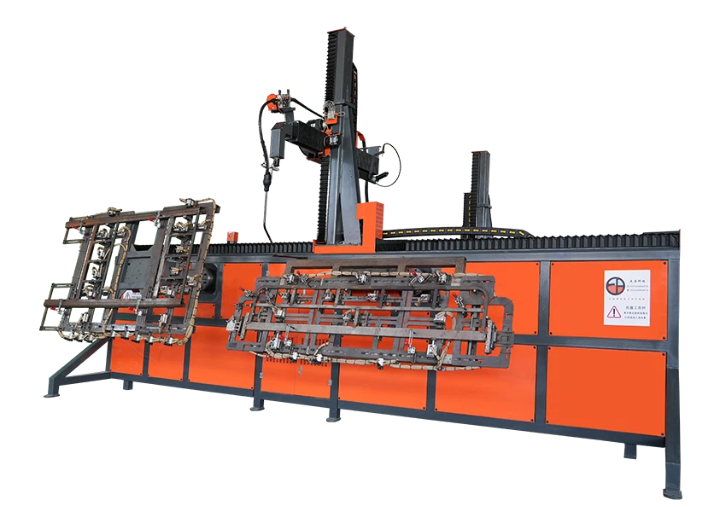
After installation, the robot needs to be programmed according to the product requirements.
Programming includes:
● Welding path setting
● Robot movement adjustment
● Welding parameter optimization
● Speed adjustment
Testing should confirm:
● Weld appearance
● Welding strength
● Production cycle time
● Robot movement accuracy
During this stage, manufacturers can optimize the robot program to achieve better efficiency and welding consistency.
Although a Welding Robot can automate welding operations, operators still play an important role in production management.
Training should include:
● Basic robot operation
● Program selection
● Workpiece positioning
● Safety procedures
● Daily inspection
Regular maintenance is also necessary to keep the Welding Robot operating reliably.
Important maintenance tasks include:
● Checking welding torch condition
● Cleaning welding spatter
● Inspecting cables
● Checking robot accuracy
● Replacing consumables
Many manufacturers believe robotic welding requires major factory changes. In reality, compact Welding Robot can often be integrated into existing production areas with proper planning.
Factories producing different products may require flexible programming and adjustable fixtures.
A programmable Welding Robot allows manufacturers to switch between different welding tasks more efficiently.
The initial cost of automation is higher than manual welding. However, manufacturers can achieve long-term benefits through:
● Higher production efficiency
● Reduced labor dependence
● Improved welding consistency
● Lower defect rates
Juyoubao provides flexible Welding Robot solutions designed for manufacturers looking to upgrade existing production lines.
The solutions are suitable for:
● Furniture welding factories
● Bicycle parts factories
● Agricultural machinery manufacturing factories
● Metal fabrication manufacturers
Juyoubao 6-axis Welding Robot help manufacturers improve:
● Welding accuracy
● Production efficiency
● Product consistency
● Automation capability
With suitable robot configuration, welding fixtures, and application support, Juyoubao helps factories gradually move from manual welding toward more efficient automated production.
Integrating a Welding Robot into an existing production line does not require completely rebuilding the factory. Through proper evaluation, equipment selection, fixture design, installation planning, and operator training, manufacturers can achieve a smoother transition to welding automation.
For companies looking to improve welding quality, increase production capacity, and reduce dependence on manual labor, a Welding Robot is a practical solution for modern manufacturing.
Learn more about Juyoubao Welding Robot solutions:
https://www.jybwelding.com/

Previous:
None

