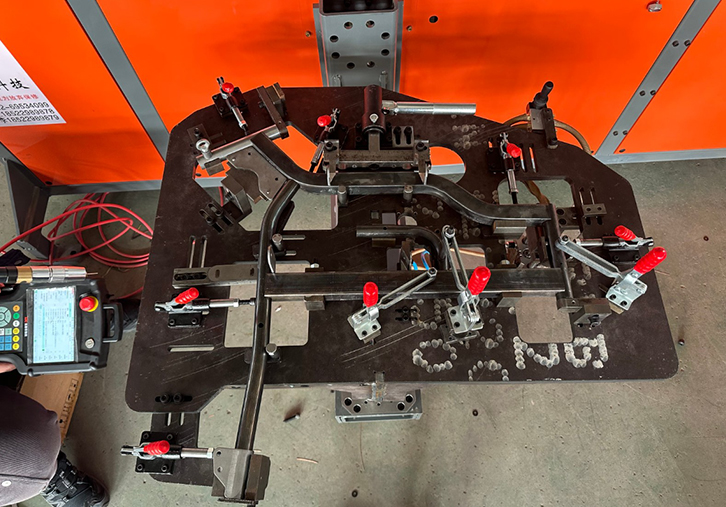
In the wheelchair manufacturing industry, welding processes directly determine the safety, durability, and comfort of the product. For a long time, frame welding has relied on skilled welders performing a step-by-step process: first, spot welding to fix the main frame; then, welding internal reinforcing ribs and connecting parts one by one; and finally, performing a full-body weld for reinforcement . This long-standing "three-step method" is not only cumbersome and inefficient, but also suffers from inconsistent weld quality and uncontrollable deformation due to the volatility of manual operation. Post-weld work often requires extensive grinding and finishing, becoming a bottleneck for improving production capacity and quality.
Today, we are officially announcing the end of this bottleneck. Through our independently developed multi-axis linkage welding robot , our company has successfully achieved a revolutionary welding breakthrough in the core frame components of wheelchairs—up to 12 workpieces can be "positioned, welded, and formed in one go . "
I. The Dilemma of Traditional Processes: The Triple Barrier of Efficiency, Quality, and Cost
The challenges of existing processes are obvious:
1. Inefficient : Three-step welding means three clamping and three positioning operations, resulting in a long cumulative working time.
2. Quality fluctuations : It is difficult to maintain the optimal heat input, speed and angle in manual welding, which can easily lead to defects such as uneven weld penetration, undercut, and porosity, posing a hidden risk to structural strength.
3. High costs : It is highly dependent on skilled workers, and the subsequent polishing process increases labor, material and time costs, and may even damage the material surface.
II. The Solution to Intelligent Innovation: Synchronization, Precision, and Perfect Integration
Our solution fundamentally restructures the welding process:
• Synchronous welding for a leap in efficiency : Utilizing high-precision customized tooling and a robotic collaborative system, all 12 major connection points of the wheelchair frame (including the main frame joint and internal reinforcement structure) can be welded simultaneously in one go . This eliminates intermediate steps, reducing the total welding time to less than one-third of the original, resulting in a geometric increase in production capacity.
• Intelligent process, superior quality : The robot is equipped with the KND welding system , which has been calibrated and trained by our company's engineers over a long period of time. It can automatically match the optimal welding current, voltage and speed according to different joint positions and material thicknesses. This ensures that each weld has a consistent penetration depth and a uniform and beautiful shape , virtually eliminating defects such as porosity and incomplete penetration, and increasing the welding qualification rate to over 99.9%.
• Near-net-shape forming, eliminating the need for grinding : Thanks to extremely high welding stability and precise heat input control, the workpiece deformation is minimal, and the weld is smooth and flat , truly achieving "welding is the final weld". After the product comes off the production line , no grinding process is required , and it can directly enter the next coating process, greatly saving costs and perfectly maintaining the integrity of the material surface.
III. Beyond Welding: Infusing Reliability and Dignity into Wheelchair Manufacturing
This technological breakthrough extends far beyond welding itself. For wheelchair users, it means that every critical point bearing their daily weight receives uniform and top-level structural strength , resulting in a comprehensive improvement in safety and durability. For manufacturers, it signifies the establishment of a stable, efficient, high-quality, and replicable standardized production process , significantly reducing quality control risks and overall manufacturing costs.
Conclusion: From "Craftsmanship" to "Programmable Perfection"
From the "three-step method" relying on personal experience to the "one-step molding" driven by digital technology, this is not only an evolution in welding techniques, but also a crucial step in wheelchair manufacturing from traditional manual labor to high-end intelligent manufacturing . What we deliver is no longer just a piece of equipment, but a certainty of quality assurance and a future-oriented productivity .
We firmly believe that the essence of technology is empowerment. This breakthrough in welding technology is helping wheelchair manufacturers worldwide provide millions of users with a more dignified mobility experience through more reliable quality and greater efficiency.