


 EN
EN

+86 139 2073 4749



 EN
EN
Welding technology plays an important role in determining product quality, production efficiency, and manufacturing costs. For industries such as metal furniture, bicycle parts, agricultural machinery, and general metal fabrication, manufacturers are constantly looking for better welding solutions to improve productivity while maintaining reliable weld quality.
Traditional arc welding systems have been widely used for decades because they are flexible, affordable, and suitable for many applications. However, with increasing labor costs and higher requirements for welding appearance and consistency, more manufacturers are considering robotic welding machines as an advanced alternative.
Both technologies have their own advantages. The right choice depends on production requirements, material characteristics, product design, and automation goals.
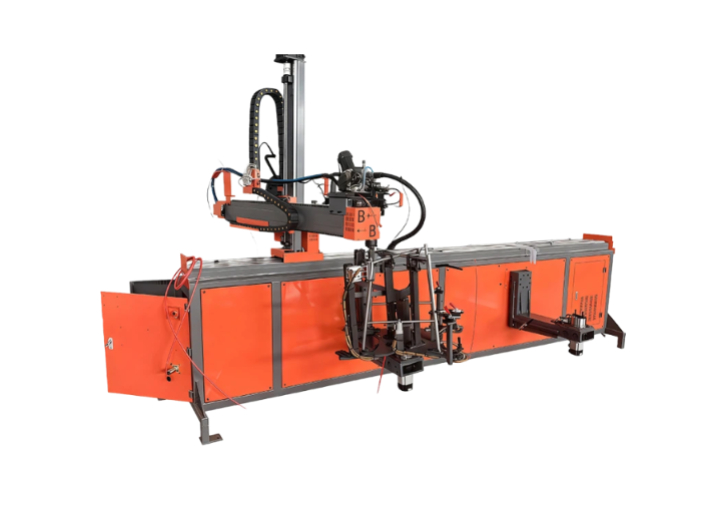
A Robotic Welding Machine combines welding technology with an industrial robotic arm to achieve automated and precise welding operations.
Unlike traditional welding methods that rely heavily on manual operation, robotic Weldinguses a programmed robot to control the movement of the welding head. The concentrated beam creates a precise weld with reduced heat impact.
A robotic Weldingsystem can automatically control:
● Welding path
● Welding speed
● Welding position
● Movement trajectory
This makes it suitable for manufacturers requiring high consistency and repeatable production.
Common applications include:
● Metal furniture frames
● Bicycle components
● Sheet metal structures
● Precision industrial parts
Traditional arc welding, including processes such as MIG/MAG welding, uses an electric arc to generate heat between the electrode and the workpiece, melting the material and forming a welded joint.
Arc welding remains one of the most common welding methods because of its:
● Lower equipment investment
● Wide material compatibility
● Simple operation
● Suitability for customized welding jobs
However, traditional arc welding quality often depends on operator skill, making consistency more challenging for large-volume production.
|
Comparison |
Robotic Welding |
Traditional Arc Welding |
|
Automation level |
Fully automated with robot control |
Mainly manual operation |
|
Welding speed |
Higher welding efficiency |
Relatively slower |
|
Weld appearance |
Smooth and clean weld seams |
More post-processing may be required |
|
Heat input |
Lower heat affected zone |
Higher heat impact |
|
Deformation |
Reduced material distortion |
Higher risk on thin materials |
|
Consistency |
Highly repeatable |
Depends on operator skill |
|
Initial investment |
Higher |
Lower |
For many manufacturers, welding appearance is a key factor, especially for products visible to end customers.
Traditional arc welding can produce strong weld joints, but the final appearance may vary depending on operator experience. In some applications, additional grinding and polishing are required to achieve a clean surface.
Robotic Weldingproduces narrow and precise weld seams with less spatter. This makes it suitable for products where appearance is important, including:
● Premium metal furniture
● Decorative metal products
The stable welding process also helps manufacturers maintain consistent quality across large production batches.
Production efficiency is one of the main reasons manufacturers consider robotic welding automation.
Traditional arc welding requires operators to manually control:
● Torch movement
● Welding speed
● Welding position
This can result in different production speeds between workers.
A Robotic Welding Machine follows programmed welding paths, allowing continuous and stable operation.
Advantages include:
● Faster welding cycles
● Reduced production interruptions
● Higher output capacity
● More predictable delivery schedules
For factories producing large quantities of metal components, automation can significantly improve overall efficiency.
Heat management is an important consideration when welding thin materials or precision components.
Traditional arc welding generates a larger heat-affected area, which may cause:
● Material deformation
● Surface discoloration
● Additional finishing requirements
Weldinguses concentrated energy, allowing heat to be applied more precisely.
Benefits include:
● Smaller heat-affected zone
● Reduced deformation
● Better dimensional accuracy
This advantage is especially useful for manufacturers working with thin tubes, and precision metal structures.
Many manufacturers are facing challenges in recruiting experienced welders. Traditional welding requires skilled operators who can maintain consistent quality over long production periods.
Robotic welding systems reduce dependence on manual welding skills by automating repetitive tasks.
Operators mainly need to:
● Set welding parameters
● Load workpieces
● Monitor production
This allows factories to improve production stability while using labor resources more efficiently.
Although robotic Weldingprovides many advantages, traditional arc welding remains suitable for some applications.
Arc welding may be a better choice when:
● Production volume is low
● Products are highly customized
● Workpieces are very large or irregular
● Initial equipment investment needs to be minimized
For repair work, prototypes, and small-batch manufacturing, manual arc welding still provides valuable flexibility.
Robotic Weldingis more suitable for manufacturers that need:
● High-volume production
● Consistent weld appearance
● Reduced manual labor dependence
● Faster production cycles
● Higher automation levels
Industries that can benefit include:
Robotic welding helps produce consistent chair frames, table frames, and other metal structures with improved appearance.
The precision of robotic welding supports accurate joining of tubular structures and lightweight components.
Automated welding improves production efficiency for repeated structural components and heavy-duty parts.
Juyoubao provides robotic welding solutions designed to help manufacturers improve production efficiency and welding consistency.
The solutions are suitable for various applications, including:
● Furniture welding factories
● Bicycle parts factories
● Agricultural machinery manufacturing factories
● Metal fabrication industries
By combining robotic movement control with optimized welding processes, Juyoubao helps manufacturers reduce manual welding challenges and build more efficient production workflows.
Both robotic Weldingand traditional arc welding have their own advantages. Traditional arc welding remains a practical choice for flexible and small-scale production, while robotic Weldingprovides greater benefits for manufacturers requiring speed, consistency, and automation.
For growing manufacturers looking to improve production efficiency and product quality, investing in robotic welding technology can provide long-term advantages.
The right welding solution should match your product requirements, production volume, and future automation plans.
Learn more about Juyoubao robotic welding solutions:
https://www.jybwelding.com/


