EN
EN

+86 139 2073 4749



 EN
EN
In today's competitive manufacturing environment, weld quality directly impacts product reliability, customer satisfaction, and production costs. While welding speed and automation are important, one of the most critical factors is robotic welding accuracy. High-precision robots deliver consistent welds by maintaining identical movements throughout every production cycle.
For manufacturers evaluating automated welding systems, understanding welding robot repeatability is essential. Repeatability influences weld penetration, bead appearance, spatter generation, and overall production consistency, ultimately determining the return on investment of robotic welding.
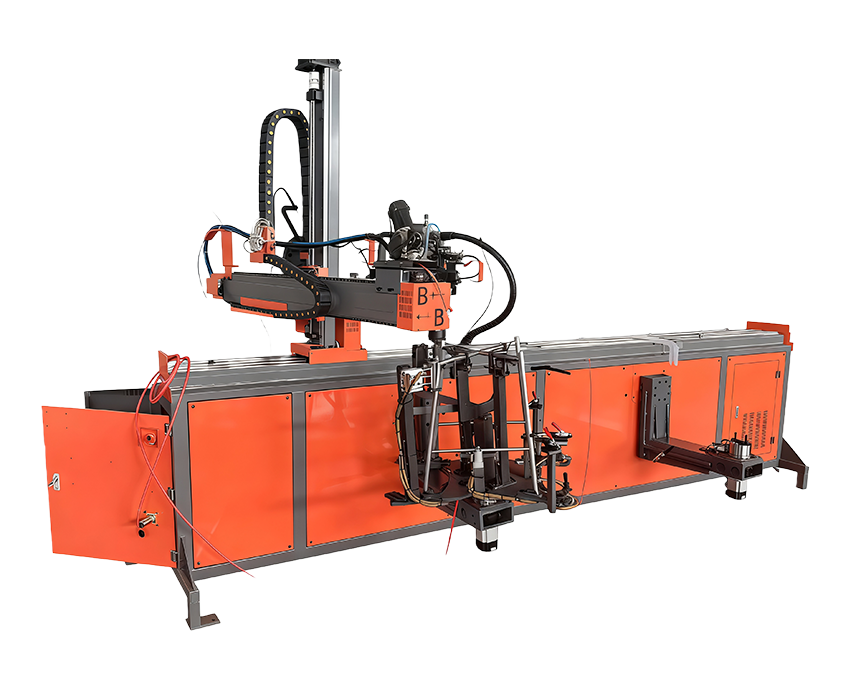
Juyoubao provides advanced robotic welding solutions with repeatability up to ±0.02 mm, helping manufacturers achieve exceptional welding precision and production stability.
Unlike manual welding, where operator skill and fatigue affect results, robotic welding follows programmed paths with exceptional consistency. High positioning accuracy ensures every weld is produced using identical motion, travel speed, and torch orientation.
Accurate robotic welding offers several advantages:
For industries such as automotive, construction machinery, heavy equipment, and metal fabrication, welding accuracy is a key competitive advantage.
Many buyers confuse repeatability with positioning accuracy, but they measure different aspects of robot performance.
Repeatability refers to the robot's ability to return to the exact same position every cycle.
For example, a robot with ±0.02 mm repeatability can repeatedly position the welding torch within an extremely small tolerance, ensuring nearly identical welds across thousands of parts.
High repeatability is particularly important for:
Path accuracy measures how precisely the robot follows the programmed welding trajectory.
Poor path accuracy may result in:
High-quality robotic systems maintain stable movement throughout the entire welding process.
Torch angle significantly influences weld formation.
A consistent torch angle provides:
If the angle changes during welding, defects such as undercut, incomplete fusion, or excessive spatter may occur.
Robotic welding maintains a fixed torch angle throughout every weld, eliminating inconsistencies common in manual operations.
Maintaining identical positioning from part to part is essential for mass production.
Stable positioning ensures:
This is especially important when welding precision assemblies requiring tight tolerances.
High repeatability directly affects overall weld quality.
Consistent positioning allows the welding arc to maintain the correct distance and travel path.
Benefits include:
Stable robotic motion minimizes unnecessary arc fluctuations.
This helps reduce:
Lower spatter also contributes to cleaner production environments.
Customers increasingly expect visually consistent welds.
Robotic welding delivers:
This is particularly valuable for products with visible welded components.
Consistent weld quality across every production batch reduces:
Stable production also improves manufacturing planning and delivery reliability.
| Manufacturing Scenario | Accuracy Requirement | Recommended Solution |
|---|---|---|
| Automotive Components | Extremely High | High-Precision Robotic Welding |
| Construction Machinery | High | Multi-Axis Welding Robot |
| Metal Furniture | Medium to High | Flexible Robotic Welding Cell |
| Heavy Steel Structures | High | Automated Welding Workstation |
| Precision Sheet Metal | Very High | Robot with ±0.02 mm Repeatability |
Manufacturers often focus on production speed, but repeatability has an equally significant impact on operational efficiency.
High repeatability enables:
As production volumes increase, these benefits become even more significant.
High-precision robotic welding is commonly used in:
These industries demand repeatable weld quality to ensure structural integrity and long-term product reliability.
Before purchasing a robotic welding system, manufacturers should evaluate:
✔ Repeatability specification
✔ Path accuracy
✔ Motion stability
✔ Multi-axis coordination
✔ Maximum payload
✔ Torch positioning precision
✔ Welding process compatibility
✔ Arc stability
✔ Programming flexibility
✔ Integration with fixtures
✔ Automation experience
✔ Engineering support
✔ Installation services
✔ Training programs
✔ Long-term technical support
A faster robot does not necessarily produce better welds.
Accuracy and repeatability often have a greater impact on overall production quality.
Even the most accurate robot cannot compensate for poor workpiece positioning.
Proper fixtures are essential for achieving repeatable weld quality.
Robot performance depends not only on hardware but also on optimized welding paths, torch angles, and process parameters.
Professional programming maximizes welding efficiency and consistency.
Juyoubao provides advanced robotic welding systems engineered for precision manufacturing.
Our advantages include:
Whether producing automotive components or heavy industrial equipment, Juyoubao helps manufacturers achieve reliable, repeatable, and high-quality welding results.
Manufacturers often evaluate robotic welding systems based on precision, reliability, and production stability.
Typical customer feedback includes:
"The robot's repeatability significantly improved weld consistency across every production batch."
"Spatter was noticeably reduced after upgrading to the automated welding system."
"The ±0.02 mm positioning repeatability helped us meet demanding customer quality requirements."
Reliable robotic welding systems provide long-term value by improving quality while reducing manufacturing costs.
The future of robotic welding is moving toward:
As manufacturing quality standards continue to rise, robotic welding accuracy will become an increasingly important factor in production competitiveness.
Robotic welding accuracy is about much more than precise movement. High repeatability, accurate welding paths, consistent torch angles, and stable positioning all contribute directly to superior weld quality.
Manufacturers seeking to improve productivity should evaluate:
By investing in high-precision robotic welding systems, manufacturers can achieve stronger welds, lower defect rates, and greater profitability.
Juyoubao delivers advanced robotic welding solutions with ±0.02 mm repeatability, helping manufacturers improve weld quality and production performance.
Contact Juyoubao to learn more about customized robotic welding automation solutions.
Email: handa@jybwelding.com
Related Products