


 EN
EN

+86 139 2073 4749



 EN
EN
Multi Dimensional Welding Robot are widely used in modern manufacturing for their flexibility, stability, and high repeatability. In metal fabrication industries, they are especially valuable for mass production of structural parts that require consistent weld quality and efficient automation.
Our Multi Dimensional Welding Robot solutions are designed specifically for CO₂ gas shielded welding and laser welding applications . They are widely applied in furniture metal frames and light-to-medium industrial metal components where productivity and consistency are critical.
A Multi Dimensional Welding Robot is an articulated robotic arm with six degrees of freedom, allowing it to perform complex welding paths in three-dimensional space. This structure enables:
Flexible welding angles
Stable torch positioning
Complex multi-direction welding paths
High repeatability in batch production
It is ideal for automated welding of standardized metal components with consistent geometry.
Our robotic welding systems are optimized for CO₂ shielded welding and laser welding, making them suitable for a wide range of metal fabrication industries.
Bed frames require strong, consistent weld joints to ensure structural stability and durability.
Typical applications include:
Metal bed frame structures
Support beams and reinforcement joints
Corner and frame welding points
Six-axis robots ensure uniform weld quality across large-scale production, reducing manual errors and improving assembly consistency.
Metal table frames often involve square or rectangular tube structures that require high-precision joint welding.
Applications include:
Dining table frames
Office desk metal supports
Industrial workbench structures
Robotic welding improves alignment accuracy and ensures consistent structural strength across batches.
Chair production requires high repeatability due to multiple identical structural parts.
Applications include:
Chair legs welding
Base support frames
Metal connectors and reinforcement joints
Automation ensures consistent geometry and reduces deformation caused by manual welding.
Our Robotic Welding Workstation systems are also widely used in photovoltaic and renewable energy metal structures, including components similar to those used in large-scale solar manufacturing ecosystems.
Applications include:
Mounting brackets
Structural support frames
Precision metal connectors
Reinforcement components
These parts require stable, high-volume welding with consistent accuracy.
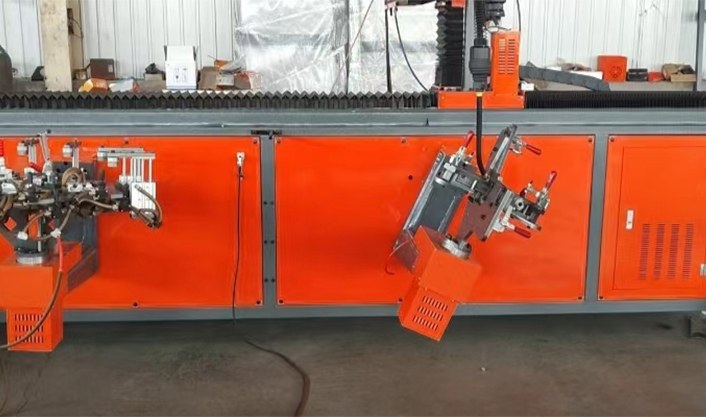
Motorcycle components require strong weld joints to withstand vibration, load stress, and long-term operation.
Applications include:
Frame structures
Brackets and support components
Metal housings and connectors
Multi Dimensional Welding Robot ensure strong penetration and stable weld quality for safety-critical parts.
Bicycle frames and components require lightweight structures with precise welding.
Applications include:
Bicycle frame welding (steel structures)
Fork and support components
Rear racks and accessory frames
Robotic welding improves consistency and reduces deformation in thin-walled metal structures.
Our Multi Dimensional Welding Robot support the following processes:
Stable arc performance
Suitable for carbon steel and structural steel
High efficiency for batch production
Widely used in furniture and industrial fabrication
High precision welding
Minimal heat deformation
Clean weld appearance
Ideal for thin or high-precision metal parts
Six-axis motion allows the robot to reach multiple welding angles without repositioning the workpiece, improving efficiency in multi-joint structures like frames and brackets.
Once programmed, the robot maintains identical welding paths for every product, ensuring consistent quality across large production batches.
Continuous automated operation significantly reduces cycle time compared to manual welding, especially in repetitive frame production.
Automation reduces reliance on skilled welders, particularly in high-volume production environments.
One system can be applied across:
Furniture manufacturing
Industrial metal fabrication
Motorcycle and bicycle components
Renewable energy structural parts
The total investment depends on system configuration and production requirements.
The robot arm itself varies based on:
Payload capacity
Reach distance
Control system level
Welding application requirements
A full system typically includes:
Six-axis robot arm
CO₂ welding power source or laser welding system
Fixtures and positioning systems
Safety enclosure
Control and programming system
Integration and tooling often represent a significant part of the total investment.
Main factors affecting total system cost:
Level of automation (semi-auto vs fully automatic line)
Welding process (CO₂ vs laser)
Workpiece complexity
Production volume requirements
Fixture design complexity
Although initial investment is higher than manual welding setups, robotic systems significantly reduce:
Labor costs
Welding defects and rework
Production downtime
Material waste
This results in strong long-term ROI, especially in medium-to-high volume manufacturing.
Juyoubao Multi Dimensional Welding Robot systems are designed for CO₂ gas shielded welding and laser welding applications, making them ideal for:
Bed frame manufacturing
Table frame welding
Chair leg production
Photovoltaic structural components (Longi-related applications)
Motorcycle parts
Bicycle parts
With high flexibility, stable performance, and strong production efficiency, these systems are a practical solution for manufacturers seeking to upgrade from manual welding to automated production and improve overall product consistency and output capacity.


