EN
EN

+86 139 2073 4749



 EN
EN
For small-to-mid-sized manufacturers, improving welding efficiency while maintaining consistent product quality has become a major challenge. Many factories still rely on manual welding, which can provide flexibility but also creates problems such as inconsistent weld quality, higher labor costs, longer production cycles, and dependence on experienced welders.
As manufacturing industries continue to move toward automation, 6-axis welding robots have become a practical solution for companies that need higher productivity without investing in overly complex industrial automation systems.
Unlike traditional welding equipment, a 6-axis robotic welding system provides multi-directional movement similar to a human arm. This allows the welding torch to reach different angles and positions, making it suitable for a wide range of metal fabrication applications.
Today, 6-axis welding robots are widely used in:
● Furniture manufacturing
● Bicycle and motorcycle parts production
● Agricultural machinery manufacturing
● Fitness equipment production
● Metal structures and industrial components
For small and medium-sized factories, the right robotic welding solution can improve production capacity while maintaining flexibility for different products.
A 6-axis welding robot is an industrial robotic arm equipped with an automatic welding system. The six axes allow the robot to rotate and move in multiple directions, providing greater flexibility compared with fixed welding machines.
The robot can automatically control:
● Welding path
● Welding speed
● Torch angle
● Movement position
● Welding parameters
This enables manufacturers to achieve stable and repeatable welding results, even when producing large quantities of similar products.
For example, when manufacturing metal chairs, bicycle frames, or agricultural machinery parts, the robot can repeat the same welding process thousands of times with consistent accuracy.
One of the biggest challenges of manual welding is that welding quality depends heavily on operator experience. Different workers may produce different weld appearances, penetration levels, and welding speeds.
A 6-axis welding robot eliminates much of this variation by controlling the welding process automatically.
The system can maintain:
● Stable welding speed
● Accurate welding position
● Consistent arc movement
● Repeatable welding quality
This is especially important for industries where product appearance and structural strength are both important, such as metal furniture, bicycle components, and precision fabrication.
For manufacturers producing export products, consistent welding quality also helps reduce rejection rates and improve customer satisfaction.
Many metal products are not simple flat structures. Components often require welding from different directions or at difficult angles.
A 6-axis robot provides flexible movement, allowing it to handle:
● Corner welding
● Circular welding
● Multi-angle welding
● Complex frame structures
For example, bicycle parts often include curved tubes and multiple joints, while agricultural machinery components may require welding large and irregular structures.
The flexibility of a robotic arm makes it easier to automate these challenging welding operations.
For factories producing repeated products, welding speed directly affects production capacity.
Manual welding requires operators to stop for breaks, reposition workpieces, and perform quality adjustments. Robotic welding systems can maintain continuous operation with stable performance.
Benefits include:
● Faster production cycles
● Reduced manual workload
● Lower production delays
● Improved delivery capability
For small and medium-sized manufacturers receiving larger orders, robotic welding can help increase output without significantly expanding the workforce.
Finding experienced welders has become increasingly difficult in many manufacturing regions.
While skilled welders remain important for product development and complex tasks, robotic welding systems can handle repetitive welding operations more efficiently.
This allows manufacturers to:
● Reduce labor pressure
● Train operators more easily
● Improve production management
● Allocate skilled workers to higher-value tasks
A robotic welding system does not replace manufacturing expertise but helps factories use their workforce more efficiently.
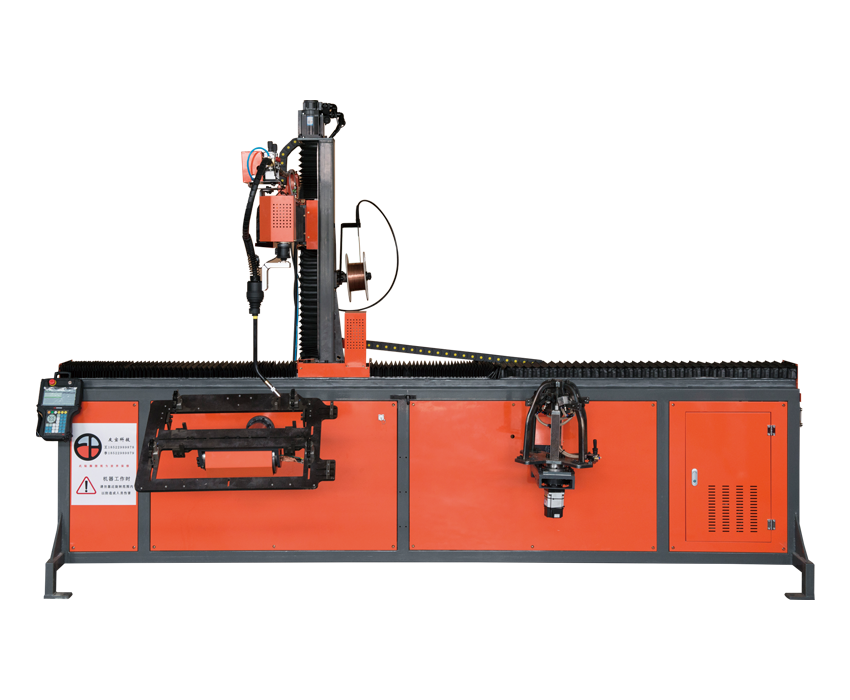
Metal furniture production often involves repeated welding of:
● Chair frames
● Table frames
● Shelves
● Outdoor furniture structures
Robotic welding improves weld consistency and reduces finishing work caused by uneven manual welding.
Bicycle and electric bicycle components require accurate welding to ensure product safety and durability.
6-axis welding robots are suitable for:
● Bicycle frames
● Metal brackets
● Structural components
The robot can maintain precise welding paths for tubular structures and repeated production models.
Agricultural machinery components often involve thick metal parts and complex structures.
Robotic welding helps manufacturers improve:
● Welding stability
● Production efficiency
● Structural consistency
It is suitable for manufacturing brackets, frames, equipment parts, and other welded assemblies.
Before purchasing a robotic welding system, manufacturers should evaluate several factors.
Different products require different robot payloads and working ranges.
Manufacturers should consider:
● Maximum workpiece weight
● Product dimensions
● Welding position requirements
A suitable robot size ensures better efficiency and avoids unnecessary investment.
A factory producing thousands of identical products may need a different solution compared with a company producing customized orders.
Consider:
● Daily production quantity
● Number of product models
● Required changeover frequency
Flexible robotic welding systems are more suitable for manufacturers with multiple product types.
Manufacturers should select equipment according to:
● Material type
● Welding thickness
● Welding method
● Required weld appearance
The right configuration helps achieve better welding performance and reduce production issues.
For manufacturers looking to upgrade from manual welding to automation, Juyoubao provides 6-axis robotic welding solutions designed for practical industrial applications.
Juyoubao welding robots are suitable for:
● Furniture manufacturing factories
● Bicycle parts factories
● Agricultural machinery manufacturing factories
● Other metal fabrication industries
The solutions help manufacturers achieve:
● Stable welding quality
● Higher production efficiency
● Flexible production capability
● Reduced dependence on manual welding
With robotic control technology and customized welding solutions, Juyoubao helps small and medium-sized manufacturers improve their production processes and move toward smarter manufacturing.
For small-to-mid-sized shops, adopting a 6-axis welding robot is no longer limited to large automotive factories. Modern robotic welding systems provide flexible, cost-effective automation options for manufacturers in many industries.
By improving welding consistency, increasing production efficiency, and reducing labor pressure, 6-axis welding robots help companies build more competitive manufacturing operations.
For manufacturers producing metal products, components, and structures, choosing the right robotic welding solution can be an important step toward improving long-term production efficiency.
Learn more about Juyoubao 6-axis welding robot solutions:
https://www.jybwelding.com/