
Because we don't provide isolated equipment, but a deeply customized turnkey project:


 EN
EN

+86 139 2073 4749



 EN
EN
Regarding the welding of agricultural machinery parts, is your welding workshop still experiencing such "process bottlenecks"?
Process fragmentation
Workers frequently switch between workstations and processes, from welding small parts to spot welding large parts and finally full welding, resulting in a stop-and-go production flow.
Efficiency bottleneck
Reliance on individual welder rhythm leads to inconsistent welding speed and quality, resulting in a significant ceiling on overall output.
Quality fluctuation
Manual operation makes it difficult to guarantee consistent weld quality, posing potential risks to product reliability and lifespan.
Dual idleness of equipment and manpower
During workpiece handling, waiting, and flipping, equipment and personnel are often in an "idle" state.
This not only results in efficiency losses but also lost profits. We have launched the "High-Efficiency Dual-Station Collaborative Welding Solution," designed to upgrade your production line from a "discontinuous flow" to a "continuous production line," maximizing the value of both equipment and manpower.
Our Solution
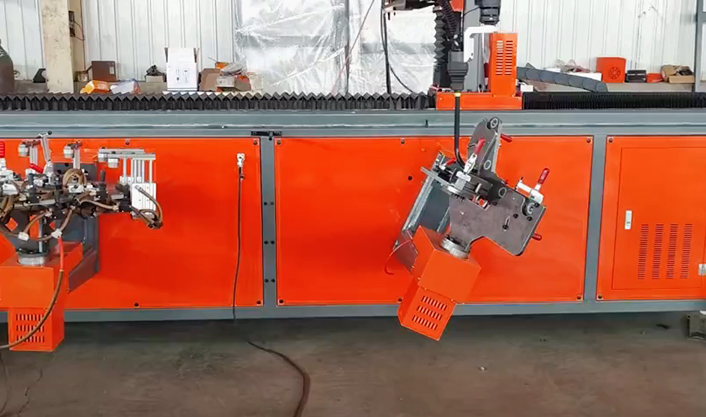
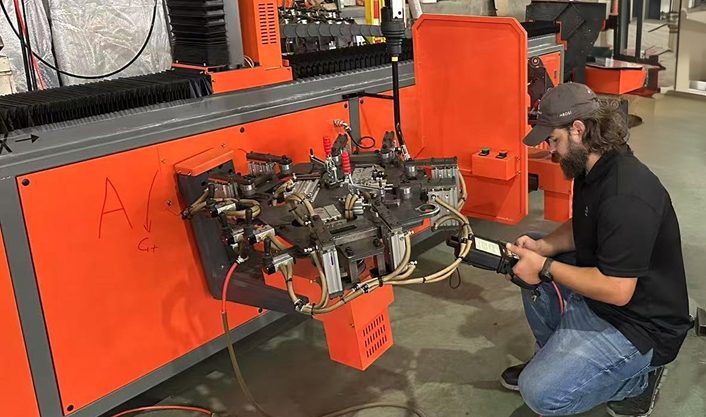
Eight-Axis Dual-Station Collaborative Welding Work Island
The core of this solution lies in a highly intelligent eight-axis dual-station welding robot workstation. It does not simply replace manual labor, but rather reconstructs the entire production process through the division of labor and perfect rhythm matching between the A and B stations, achieving "uninterrupted equipment operation, uninterrupted welding, and uninterrupted output."
Operational Flow Analysis
Station A (High-Efficiency Welding of Small Parts):
• Process: Utilizes continuous welding technology for high-speed, continuous welding of 5 small parts on the front side, ensuring full and efficient welds.
• Action: After welding the front side, immediately perform the same high-quality continuous welding on the remaining 5 small parts on the back side.
• Cycle Time: The entire "front welding + flipping + back welding" process is optimized and controlled to 58 seconds.
Station B (Precision Welding of Large Parts)
• Process: Employs pulse welding technology, specifically for handling two slightly larger parts that are more sensitive to heat input and have higher requirements. Pulse welding concentrates energy and minimizes deformation, achieving higher strength and more aesthetically pleasing welds.
• Cycle Time: The total precision welding time is optimized to 57 seconds.
The Wisdom of the "Work Island": The cycle times of Station A and Station B (58 seconds vs. 57 seconds) are precisely designed for seamless integration. While welding is being performed at Station A, workers can load and unload materials at Station B; and vice versa. Both equipment and workers achieve "zero waiting time," forming a highly efficient, cyclical, and uninterrupted production work island.
The Core Value It Brings to You
Increased Efficiency
Unified Quality
Cost Optimization
Management Upgrade
Increased Efficiency, Breaking Through Capacity Ceilings
Integrating previously fragmented and intermittent processes into two parallel, continuous automated workflows significantly reduces the overall welding time per unit.
The "non-stop equipment, non-idle workers" model increases overall production efficiency by over 50%, completely breaking through capacity bottlenecks.
Uniform Quality, Creating Reliable Products
Robotic welding ensures that the parameters, path, and speed of every weld are absolutely consistent, completely eliminating human variability.
Targeted processes (continuous welding for efficient small parts, pulse welding for high-quality large parts) ensure optimal welds for each component, significantly improving product pass rate and consistency.
Optimized Costs, Enhanced Competitive Advantage
Reduces the absolute reliance on top-tier welders' skills; one worker can easily manage the operation and loading/unloading of the entire work cell.
Stable welding quality reduces rework, repairs, and subsequent grinding costs, significantly lowering long-term overall manufacturing costs.
Upgraded Management, Predictable Production
Fixed production cycle and stable, predictable output facilitate accurate production planning and delivery.
Digitalized and standardized production model makes management simpler and easier.
Why Are We Your Reliable Partner?
Because we don't provide isolated equipment, but a deeply customized turnkey project:
Process package solidification
We will pre-develop and test all welding processes specific to your wheelchair model, solidifying the optimal parameters into the system.
Rapid ROI
Typically, the equipment investment can be recovered within 6-10 months through savings in labor, consumables, and incremental profits from increased efficiency.
Continuous support
From installation and commissioning, personnel training to process optimization, we provide full lifecycle support to ensure continuous and stable output.
